Disclosure: RCM First LLC published this guide, and we list ourselves first. We explain exactly why in the ranking criteria below, and we also say where another company may be a better fit than we are. Competitor details come from each company’s own public website and were checked in October 2026. Verify anything important directly with the company before you sign.
If you are searching for the best medical credentialing companies in Texas, you have probably noticed that most lists are written by the companies being ranked, with no explanation of how the order was chosen and no pricing, timelines, or sources. This guide tries to do better. It explains how Texas credentialing actually works, what to ask any vendor, and how six credentialing companies serving Texas providers compare.
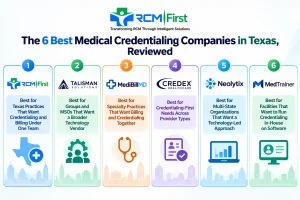
Best Medical Credentialing Companies in Texas: Quick Comparison
| Company | Based in | Credentialing offering | Best for |
|---|---|---|---|
| 1. RCM First LLC | DFW, Texas | Credentialing, payer enrollment, CAQH, recredentialing, payer contracting, plus medical billing | Texas practices that want credentialing and billing run by one team |
| 2. Talisman Solutions | Dallas, Texas | Provider credentialing, payer enrollment, delegated credentialing for groups | Group practices and MSOs that want a larger RCM and technology vendor |
| 3. MediBillMD | Dallas, Texas | Medical credentialing alongside billing, coding, and AR recovery | Specialty practices that want billing and credentialing together |
| 4. Credex Healthcare | Jacksonville, Florida | Credentialing, CAQH setup, maintenance, enrollment, licensing | Credentialing-first needs across many provider types and states |
| 5. Neolytix | Chicago, Illinois | Credentialing (CVO), payer enrollment, multi-state licensing, AI automation platform | Multi-state organizations that want a technology-led approach |
| 6. MedTrainer | Not stated on its site | Credentialing software plus managed credentialing services | Facilities that want to run credentialing in-house on a software platform |
Several of these companies are national rather than Texas based. We include them because they actively serve Texas providers, and because the right answer for a 40 physician multi-state group is different from the right answer for a three provider clinic in Tarrant County.
How We Ranked the Best Medical Credentialing Companies in Texas
Most credentialing company lists never state their criteria. Here are ours, so you can judge the ranking yourself:
- Texas payer and program knowledge. Familiarity with the Texas Standardized Credentialing Application, Texas Medicaid and CHIP enrollment, and how Texas commercial payers handle credentialing.
- Credentialing connected to billing. Whether enrollment, effective dates, and claims are managed together. Many billing denials trace back to an enrollment gap.
- Scope after approval. Recredentialing, CAQH attestation, demographic updates, and payer contract review, not just the first application.
- Transparency. Clear communication, documented follow-up, and no guaranteed approval dates, since no vendor controls payer decisions.
- Fit by practice size and type. Whether the company is built for solo practices, groups, or large organizations.
Why we put RCM First first: we are the publisher, and we score ourselves highest on criteria 1 and 2 for small and mid-sized Texas practices. We do not claim to be the best choice for every organization. For a hospital system or a multi-state enterprise, one of the options below may suit you better, and we say so in each profile.
How Medical Credentialing Companies in Texas Actually Work
Before comparing vendors, it helps to know what they are doing on your behalf. Credentialing in Texas involves several separate tracks, and a good credentialing company manages all of them.
Commercial Payers and the TSCA
For HMOs, Texas uses the Texas Standardized Credentialing Application (TSCA). The Texas Department of Insurance publishes the form and the rules around it. According to TDI, an HMO must give written notice of acceptance or non-acceptance within 90 days of receiving a provider’s application, the credentialing committee must complete initial credentialing within 180 calendar days, the applicant must be told of the committee’s decision within 60 days, and participating providers must be recredentialed every 3 years. TDI’s page notes it was last updated in July 2023, so confirm current rules before you rely on them.
Those are regulatory outer limits, not typical turnaround. A credentialing company’s job is to keep your application complete enough that it does not sit in a queue waiting for missing documents.
CAQH
Many health plans pull provider data from a CAQH profile. An incomplete or unattested profile is one of the most common reasons an application stalls. Ask any credentialing company who owns CAQH maintenance and how often it is reviewed.
Medicare
Medicare enrollment uses the CMS-855I application for individual practitioners, typically submitted through PECOS. Your Medicare effective date depends on filing, and retroactive billing is limited. Under 42 CFR 424.520, the effective date is the later of the filing date of an application that is later approved or the date you first began furnishing services at a new location. 42 CFR 424.521 allows limited retrospective billing, generally up to 30 days, only when circumstances precluded enrollment in advance.
Texas Medicaid and CHIP
Texas Medicaid and CHIP provider enrollment runs through the state’s Provider Enrollment and Management System (PEMS), administered with TMHP. Ask any vendor whether they handle PEMS enrollment and taxonomy attestation directly.
Texas Licensing
Credentialing starts with an active license. Physicians are licensed by the Texas Medical Board, and the process has its own fees and timelines. See our full guide to Texas medical license requirements.
The 6 Best Medical Credentialing Companies in Texas, Reviewed
1. RCM First LLC: Best for Texas Practices That Want Credentialing and Billing Under One Team
Based in: Bedford, Texas (Dallas-Fort Worth area) Website: rcmfirst.com
RCM First combines medical credentialing and payer contracting with full-service medical billing and revenue cycle management, with more than 15 years of experience in both. That combination is the main reason we rank first on our own list: the team that submits your enrollment applications is the same team that sees your claims, so an enrollment gap shows up as a billing problem we can trace and fix instead of a handoff between two vendors.
What RCM First covers:
- Initial provider credentialing and enrollment
- CAQH registration and ongoing profile maintenance
- Adding a physician to an existing group contract
- Adding a new practice location
- Payer contract review and reimbursement rate discussions
- Recredentialing tracking and renewal deadlines
- Demographic and practice information updates
What we do not promise: guaranteed approvals, immediate effective dates, or predetermined rate increases. Those outcomes depend on payer decisions. We commit to a structured process, documented follow-up, and honest status updates.
Where RCM First may not be the best fit: a large hospital system that needs privileging and medical staff office software, or a multi-state enterprise that wants a pure technology platform. For those needs, MedTrainer or Neolytix, below, may suit you better.
Best for: solo physicians, new practices, and small to mid-sized groups in Texas that want credentialing connected to billing. See our complete guide to medical credentialing services or request a free practice audit.
2. Talisman Solutions: Best for Groups and MSOs That Want a Broader Technology Vendor
Based in: Dallas, Texas Website: talismansolutions.com
Talisman Solutions describes itself as a U.S.-based healthcare technology and services company with more than 20 years of experience. Its offering is broad: revenue cycle management, billing, coding, compliance, EHR, medical transcription, and payer services. Provider credentialing is listed under its RCM services, with credentialing and payer enrollment for individual providers and delegated credentialing for group practices and MSOs.
Worth knowing: because the company covers a wide range of services, credentialing is one of many offerings. Ask how much dedicated credentialing staff will work on your account.
Best for: larger groups and MSOs that want one vendor across RCM, technology, and credentialing.
3. MediBillMD: Best for Specialty Practices That Want Billing and Credentialing Together
Based in: Dallas, Texas (address listed on its site) Website: medibillmd.com
MediBillMD offers revenue cycle management and medical billing, and lists medical credentialing among its services alongside coding, denial management, billing audits, and old AR recovery. Its site states it is trusted by 200+ healthcare practices and names specialties including cardiology, neurology, OB/GYN, oncology, and orthopedics. The site describes credentialing in general terms and does not break out specific credentialing sub-services.
Worth knowing: ask for details on what the credentialing service includes, such as recredentialing and CAQH maintenance, since the public description is brief.
Best for: specialty practices looking for a billing company that also handles enrollment.
4. Credex Healthcare: Best for Credentialing-First Needs Across Provider Types
Based in: Jacksonville, Florida (serves all 50 states) Website: credexhealthcare.com
Credex Healthcare describes itself as a credentialing, billing, and licensing company. Its listed credentialing services include physician credentialing, nurse practitioner credentialing, behavioral health credentialing, psychologist and therapist credentialing, CAQH profile setup, credentialing maintenance, and provider enrollment, plus credentialing for dental, home health, and pharmacy settings.
Worth knowing: some third-party lists place Credex in Houston, but its own site lists a Jacksonville, Florida address. Because it is not Texas based, ask about its experience with Texas-specific processes such as the TSCA and Texas Medicaid PEMS enrollment.
Best for: providers who want a credentialing-focused vendor and have a mix of provider types or multiple states.
5. Neolytix: Best for Multi-State Organizations That Want a Technology-Led Approach
Based in: Chicago, Illinois (serves 40 states per its site) Website: neolytix.com
Neolytix offers revenue cycle management, billing, and compliance, with credentialing (CVO), provider enrollment, and multi-state medical license management. It promotes an AI-powered credentialing automation platform called InCredibly. Its site states it serves 40 states and 31 specialties.
Worth knowing: Neolytix also publishes its own Texas credentialing list with itself in first place, and some performance figures on its materials do not cite a source or methodology. Ask any vendor, including us, how a performance claim was measured.
Best for: multi-state groups and organizations that value an automation platform.
6. MedTrainer: Best for Facilities That Want to Run Credentialing In-House on Software
Website: medtrainer.com
MedTrainer is a healthcare compliance software company with Learning, Credentialing, and Compliance product areas. Its credentialing tools cover provider enrollment, privileges and appointments, exclusions monitoring, and provider data management, and it also lists managed credentialing services. Its site says it has served 32,000+ healthcare facilities since 2013 and serves settings from physician offices and urgent care to hospitals and health systems.
Worth knowing: MedTrainer is primarily a software platform. If you want a team to do the work for you rather than a tool for your staff to use, confirm exactly what its managed service includes.
Best for: hospitals, health systems, and larger facilities with an in-house credentialing team.
How to Choose Among the Best Medical Credentialing Companies in Texas
Whichever company you consider, ask these questions in writing before you sign:
| Question | Why it matters |
|---|---|
| Who handles CAQH maintenance and attestation? | An out-of-date profile can stall applications |
| Do you handle Texas Medicaid and CHIP enrollment directly? | PEMS enrollment is a separate track |
| How do you track and confirm effective dates? | Effective dates determine what you can bill |
| What happens after approval? | Recredentialing, renewals, and updates are ongoing work |
| How do you connect to billing? | Enrollment problems often surface as denials |
| What is your fee model, and what is excluded? | Avoid surprise charges for adding providers or locations |
| How are your performance claims measured? | Percentages without a method are marketing, not evidence |
| Who is my single point of contact? | Accountability prevents applications from sitting idle |
| What do you not promise? | Honest vendors do not guarantee approval dates or rate increases |
Common Mistakes When Hiring Medical Credentialing Companies in Texas
- Choosing on a headline number. A claimed approval rate without a method tells you little.
- Treating credentialing as one-time. Recredentialing happens on a cycle, and TDI notes HMOs must recredential providers every 3 years.
- Assuming a CAQH profile covers every payer. Many payers still require separate applications.
- Billing before effective dates are confirmed in writing. This is the most expensive mistake on the list.
- Hiring separate vendors for credentialing and billing without a clear handoff. Gaps between them are where claims get denied.
- Waiting until after the license is issued to plan enrollment. Start the planning in parallel. See our guide on the steps between licensure and your first paid claim.
Medical Credentialing for Texas Practices by Specialty
Credentialing priorities vary by practice type. Explore how billing and enrollment come together in the specialties we support:
- Mental health billing
- Family medicine billing
- Internal medicine billing
- Urgent care billing
- Neurology billing
- Cardiology billing
- Orthopedic billing
- OB/GYN billing
FAQs About the Best Medical Credentialing Companies in Texas
What is the best medical credentialing company in Texas? It depends on your size and needs. For small and mid-sized Texas practices that want credentialing and billing managed together, RCM First is built for that. For large hospital systems or multi-state enterprises, a software-led option such as MedTrainer or a larger vendor may fit better.
How long does medical credentialing take in Texas? It varies by payer, specialty, and how complete your application is. Texas Department of Insurance rules set outer limits for HMOs, such as a 90 day acceptance notice and a 180 day maximum for completing initial credentialing, but actual turnaround differs by payer. No honest company can guarantee a specific approval date.
How much do credentialing companies charge? Pricing models vary, including per-provider, per-payer, flat project fees, and monthly maintenance. Because published pricing is rare, ask for a written scope showing what is included and what costs extra.
What is the TSCA? The Texas Standardized Credentialing Application is the form HMOs use to verify the credentials of the physicians and providers they contract with. TDI publishes it on its website.
Does CAQH credential me with every payer? No. Many payers use CAQH data, but separate applications, documents, and enrollment steps may still be required.
Do I need a credentialing company, or can I do it myself? You can do it yourself, but it is time consuming and the cost of an error is delayed billing. Practices commonly outsource when adding providers, opening locations, or when staff do not have time to follow up with payers.
Does RCM First guarantee credentialing approval? No. Approvals, effective dates, and contract terms are payer decisions. We manage the process, document follow-up, and keep you informed.
Can RCM First help after the credentialing is approved? Yes. We handle recredentialing deadlines, CAQH attestation, demographic updates, and the medical billing that follows enrollment.
Get Credentialed Faster: Work with a Top Medical Credentialing Company in Texas
If you are comparing the best medical credentialing companies in Texas, the most useful first step is a clear picture of your own enrollment status. RCM First can review where your providers stand with each payer, identify gaps, and map the next steps, with credentialing and billing handled by one team.
Request a free practice audit or read our medical credentialing services guide.